
TL;DR Takeaways by Hatchet:
- VTuber viewership has doubled over the past few years, accounting for 7.3% of all live streaming viewership on Twitch and YouTube Gaming in Q4 2025
- Japanese VTuber agencies Hololive and Nijisanji manage the most successful VTubers, but independents and Korean VTubers are making a splash in 2026
- Sponsorship opportunities with VTubers are more popular than ever thanks to their broad appeal and fiercely devoted fans
VTubers are the vanguard of the live-streaming industry, pushing the medium to its limits at the intersection of technology, identity, and culture. Rather than showing their own face, these creators perform entirely through digital avatars, building alternate personas that fans invest in just as deeply as they would a real person’s channel. This isn’t a fringe curiosity anymore: VTubers have become one of the fastest-growing forces in live streaming, carving out a devoted global audience that keeps expanding year after year. As this format matures, brands and publishers alike need to understand exactly how VTubers operate, and what makes their fanbases so uniquely valuable.
In this article, we’ll break down where VTubing came from and why it’s grown so quickly, then turn to a fresh sample of the Top 100 VTubers by hours watched to see exactly who’s leading the pack today. From there, we’ll dig into what these top VTubers stream, which games and moments draw their biggest audiences, and how agencies and sponsorships continue to shape the business behind the avatars. Whether you’re already familiar with the VTuber space or entirely new to it, this piece should offer a clear, up-to-date picture of one of live streaming’s most distinctive corners.
Looking for something specific? Skip to the relevant section here:
- VTuber History and Rise to Prominence
- The Top 100 VTubers: Popular streamers, games, and collaborations
- The Business of VTubers: Agencies and brand sponsorships
The Explosion of Demand for VTubers: From Japan to Global Phenomenon
VTubers, short for Virtual YouTubers, are streamers who present themselves as digital avatars driven by motion capture technology instead of showing their own face. The format traces back to Kizuna AI, who coined the term with her 2016 debut and reached millions of subscribers within her first year alone. Her success proved that VTubers could command intensely loyal followings, even when compared to traditional streamers. This idea, that a virtual identity could carry as much weight as a real one, became the foundation for everything that followed.
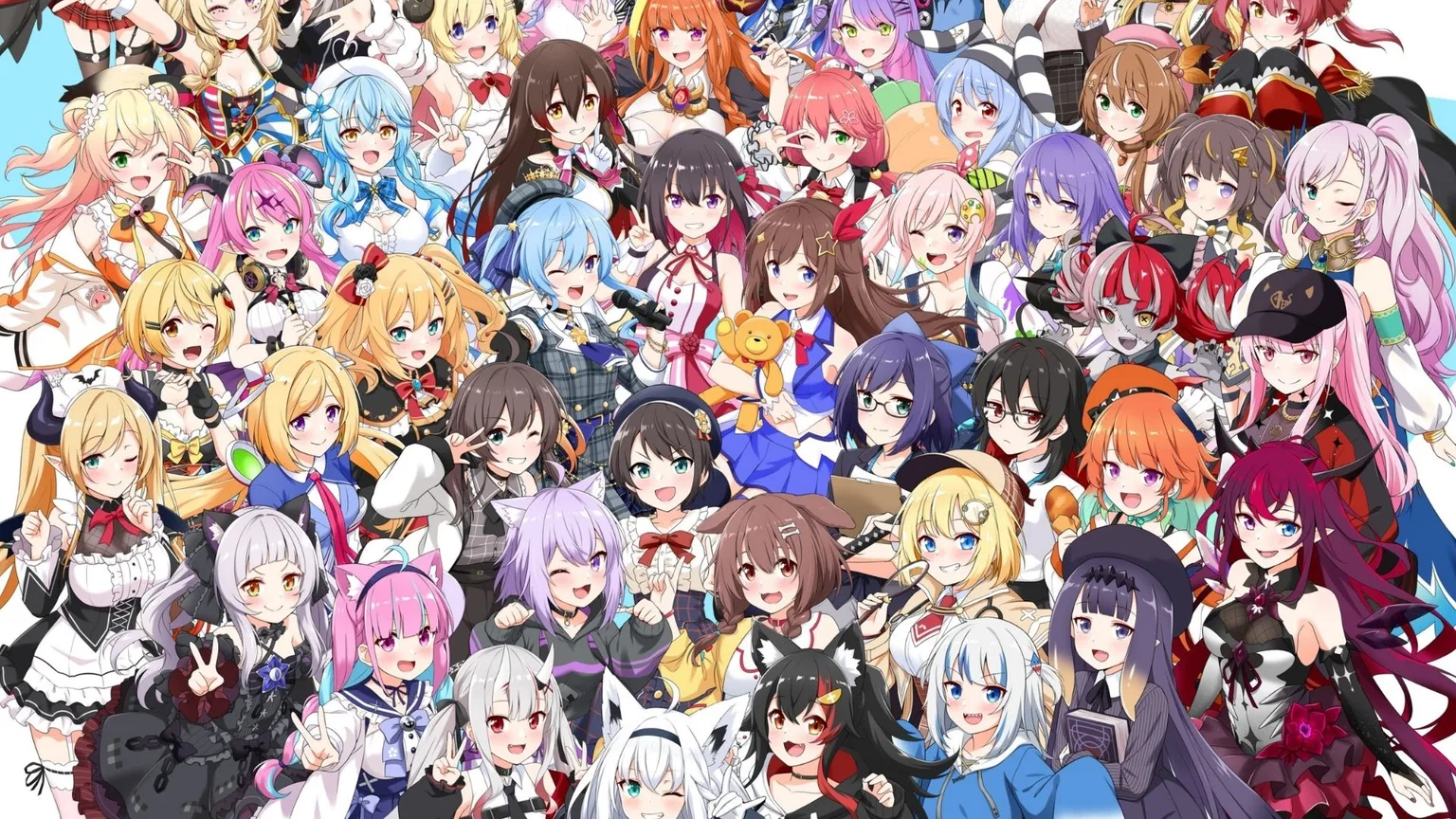
By 2018, VTubing shifted from an independent hobby into a corporate industry, as Hololive Production and Nijisanji launched and began signing rosters of talent under agency management. VTuber agencies are essentially like talent agencies that manage VTubers, putting them into groups for collaborations and supporting the financial side of their craft with merchandising, concerts, and sponsorships. This agency model borrows directly from Japanese idol culture, where performers cultivate hyper-optimistic onstage personas built around singing, dancing, and elaborate 3D concerts. The result is a fanbase dynamic built on intense devotion, demanding emotional investment beyond what so-called “Flesh Tubers” (non-VTubers) can expect from their fans.
VTubing’s popularity accelerated sharply during the pandemic, when stay-at-home audiences worldwide had the time and appetite to explore this niche corner of streaming. What began as a primarily Japanese phenomenon has since extended its global reach considerably. As demand grew, more agencies popped up to support this expansion, including ones focused on English-speaking talent and others carving out room for more niche VTuber communities. Advances in translation and captioning technology also made it easier for fans anywhere to follow their favorite talent, spreading VTubing well beyond its home market within just a few years.
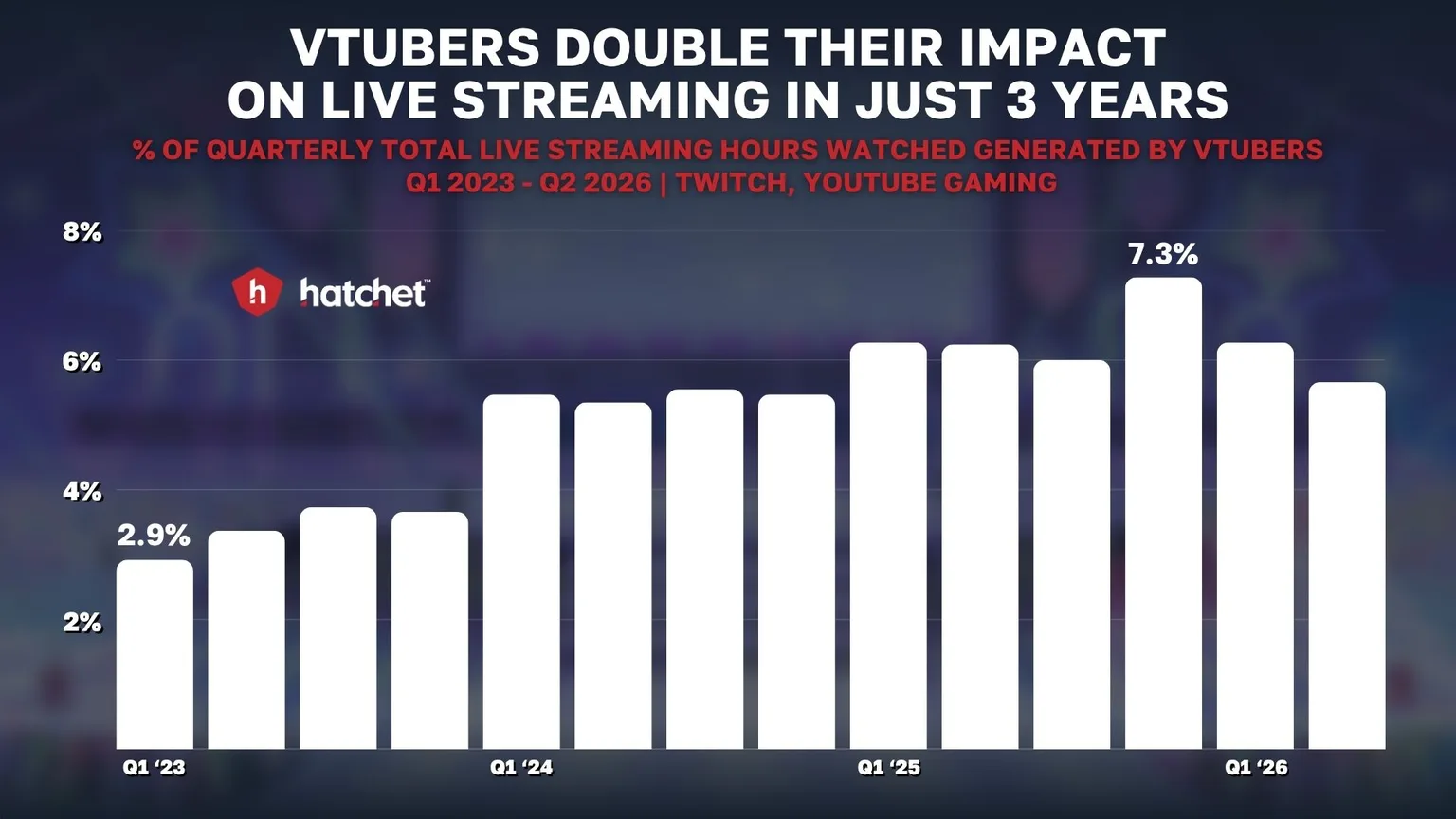
If there’s one number that captures VTubers’ rise over the past few years, it’s this: Their slice of overall live-streaming hours watched has more than doubled since 2023. VTuber content made up just 3% of total Twitch and YouTube Gaming hours watched in Q1 2023, but by Q4 2025 that had climbed to a peak of 7%. That kind of jump doesn’t happen through steady, gradual growth, it points to a real shift in demand, with VTuber content increasingly becoming a bigger part of what audiences want to watch.
What makes this growth even more impressive is the backdrop it happened against. Total live-streaming viewership across Twitch and YouTube Gaming barely moved over the same period, while VTuber hours watched alone nearly doubled in absolute terms. VTubers weren’t simply riding a rising tide of overall streaming growth. Their gains came largely at the expense of other content competing for the same audience. Since that late-2025 peak, VTuber share has settled into a slightly lower but still healthy range, suggesting the format has found a stable new normal rather than cooling off.
Taking a Sample: The Top 100 VTubers and Their Platforms
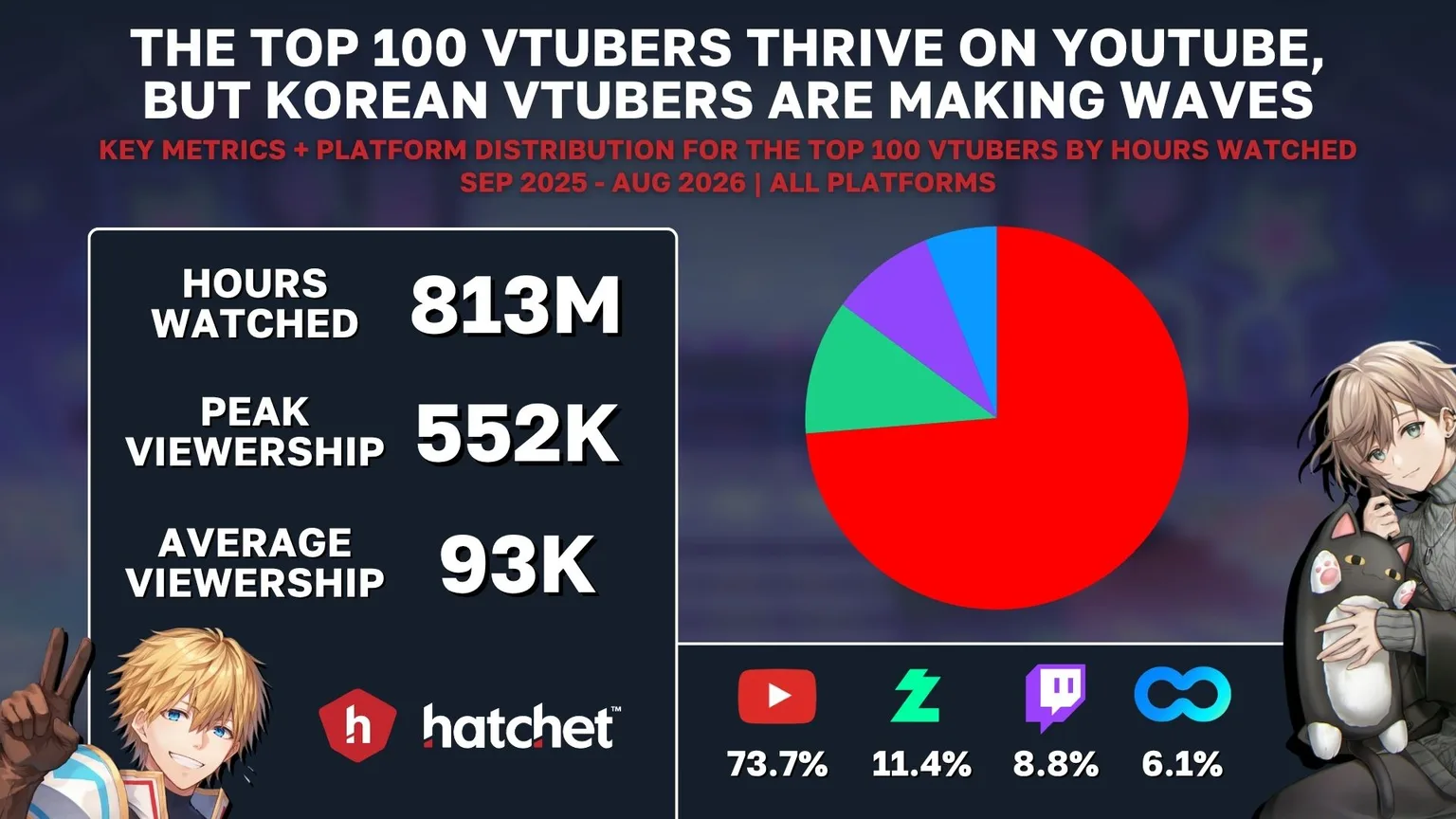
To get a clearer picture of what’s driving VTubers’ growth, we pulled a sample of the Top 100 VTubers by hours watched across all platforms, covering September 2025 through August 2026. This sample gives us a much closer look at exactly how the most popular VTubers are keeping audiences hooked, from where they’re watched to what keeps people tuning in. The rest of this article draws on this same Top 100 sample throughout.
Note: We have made one notable exception here. Although TheBurntPeanut is technically a VTuber, his target audience, content style, and aesthetic are vastly different. As such, he has not been included in the Top 100 VTubers.
The numbers here speak to just how big this space has become: 813.0M hours watched, a peak viewership of 552K, and an average viewership of 93K across the Top 100 over the past 12 months. YouTube remains the clear home base for these top-tier VTubers, capturing 73.7% of hours watched, far ahead of every other platform. What’s more surprising is who’s in second place: Korean platform Chzzk pulls in 11.4%, edging out Twitch’s 8.8% despite Twitch being the more globally established platform. Add in fellow Korean platform SOOP at 6.1%, and Korean platforms combined account for 17.5% of hours watched, comfortably outpacing Twitch on its own.
The 10 Biggest VTubers in the World Right Now
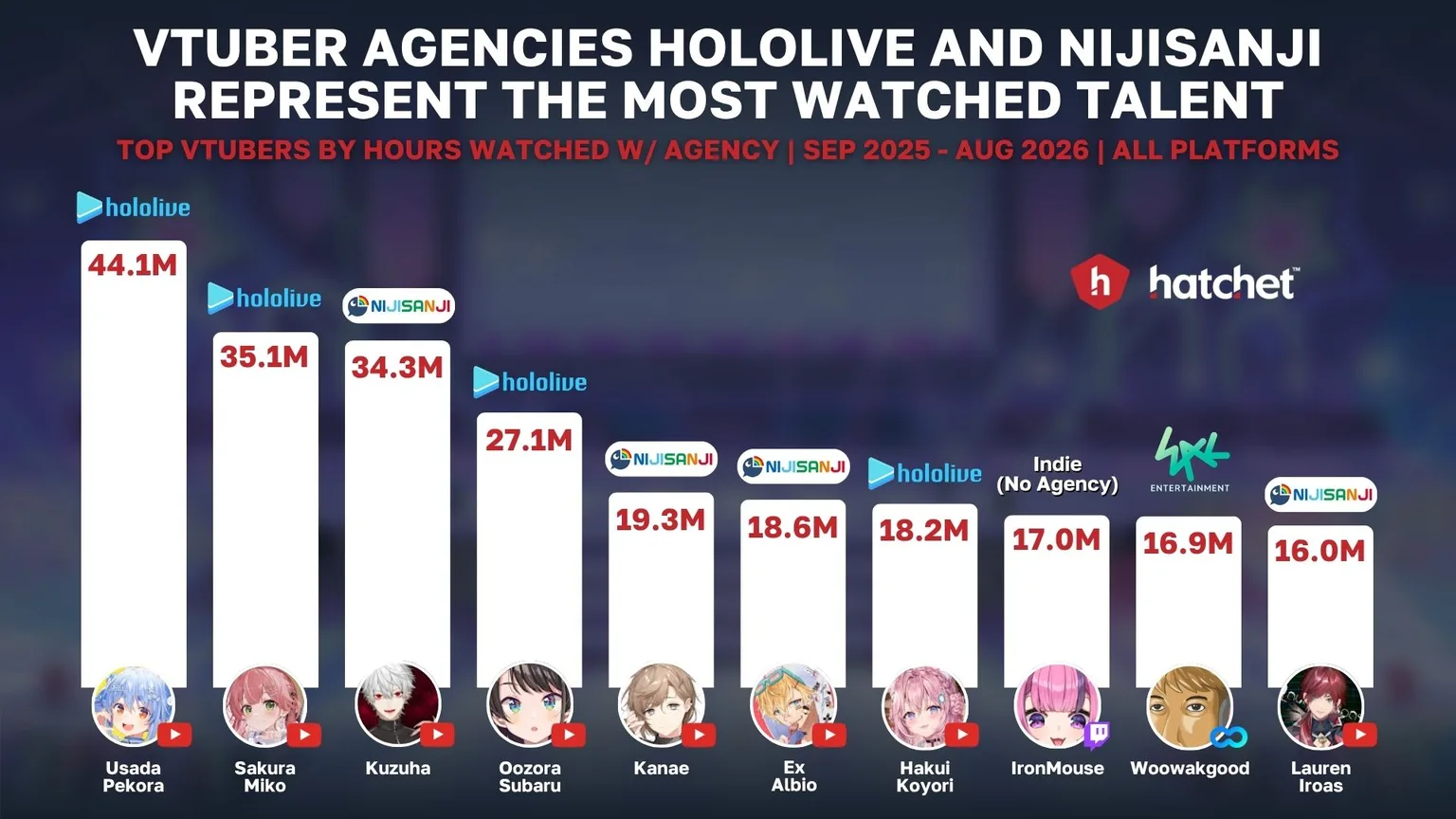
The Top 10 makes it clear who still dominates VTubing’s biggest stage: Hololive and Nijisanji, evenly split with four spots each. But the split runs deeper than just agency name. Every Hololive VTuber in the Top 10 is female, while every Nijisanji VTuber here is male, splitting the ranking almost perfectly down gender lines. Usada Pekora leads the pack overall with 44.1M hours watched, well clear of Sakura Miko and Kuzuha, who are locked in a close race for second at 35.1M and 34.3M respectively.
The remaining two names break the mold entirely. Ironmouse and Woowakgood are the only Top 10 VTubers without ties to Hololive or Nijisanji, and each got there through a completely different route. Ironmouse spent five years as a founding member of VShojo before parting ways with the agency in 2025, and now streams as an independent VTuber, continuing to focus much of her energy on fundraising for the Immune Deficiency Foundation. Woowakgood, meanwhile, isn’t independent talent at all: He’s a veteran Korean streamer who built his own idol group, ISEGYE IDOL, from his own fanbase in 2021, then founded his own agency, WAK Entertainment, to run it.
What Games do the Top VTubers Play?
Minecraft tops the list at 41.0M hours watched, with GTA V close behind at 40.0M, and it’s no coincidence that both are open-ended, user-generated worlds rather than games with a fixed objective. That kind of format lends itself naturally to group storytelling, letting dozens of VTubers build out shared characters and plotlines together rather than just competing for a win. Just Chatting rounds out the top three at 34.4M hours, a reminder that pure personality-driven content still pulls serious numbers on its own. Further down, Japan-centric titles like Street Fighter 6 (20.7M) and Powerful Pro Yakyū 2026-2027 (10.5M) hold their own alongside more globally familiar competitive picks like Valorant, Rust, WWE, and Apex Legends.
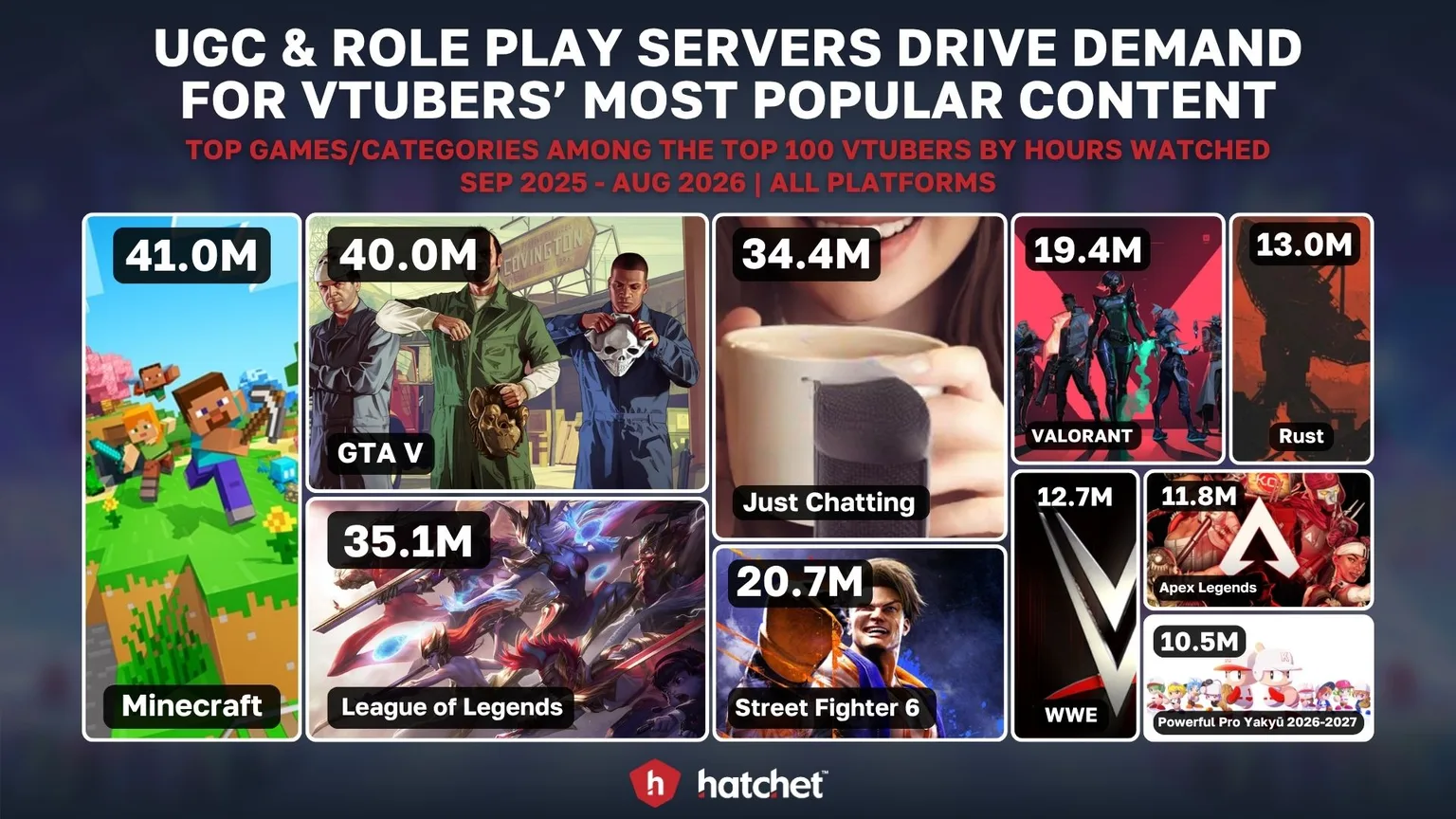
Minecraft and GTA V’s popularity plays out through dedicated roleplay servers built specifically for VTuber collaboration. Hololive’s “Hololive GTA” event placed over 40 talents into a custom server called Holo Santos, each taking on a role like police officer, mechanic, or shop owner. Nijisanji runs a similar setup year-round through VCR GTA, plus Minecraft servers like Niji ENchanted where talents build entirely new personas and storylines together. Its English offshoot, District V, even opens the door to VTubers outside Nijisanji entirely.
Competitive titles bring VTubers together through tournaments instead. Nijisanji’s Kuzuha hosts a recurring Street Fighter 6 event called KZHCUP for fellow talent, while the larger V-Saikyo tournament pulls four-person teams from across Nijisanji, Hololive, VSPO!, and REJECT into the same bracket. Capcom has leaned into this crossover too, running official Street Fighter 6 merchandise collaborations with Nijisanji talent two years running. These formats give competitive games their own version of the collaborative pull that roleplay servers offer elsewhere.
VTubers Bring in Audiences with Anniversary Events and Competitive Collabs
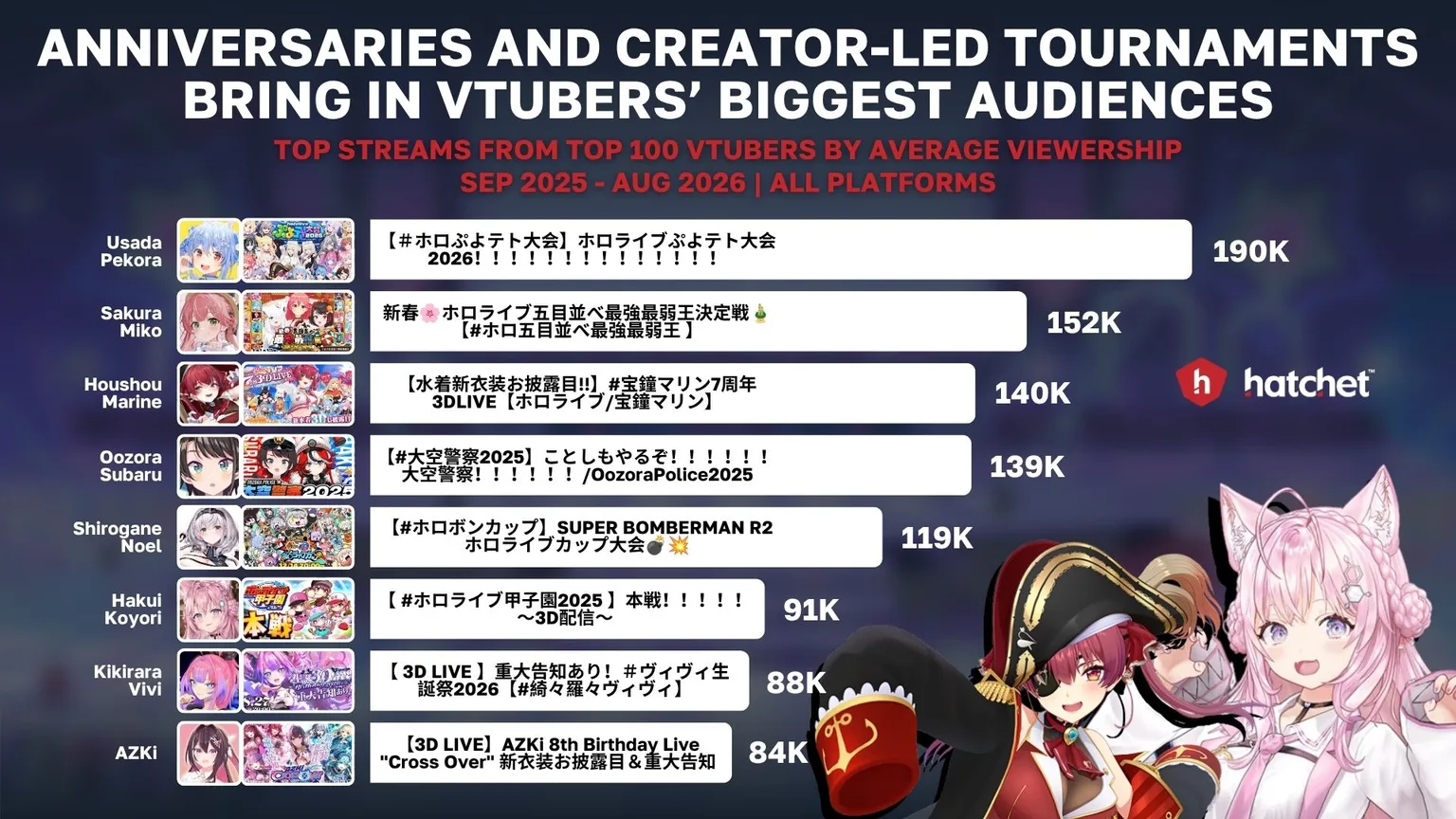
To see what pulls in the biggest live crowds, we ranked every stream from the Top 100 VTubers by average viewership, then took just the single highest-performing stream from each VTuber. The results look nothing like our earlier games breakdown: None of the top streams here involve Minecraft, GTA V, or Just Chatting, the very titles racking up the most total hours watched. Instead, creator-led tournaments dominate. Usada Pekora’s Puyo Puyo Tetris Tournament tops the list at 190K average viewers, followed by a Gomoku championship (152K), a Bomberman Cup (119K), and the Hololive Koshien finals (91K), all multi-talent events built around a single big competitive moment rather than everyday gameplay.
Anniversaries and birthdays make up the rest of the list, and they clearly function as appointment viewing. Houshou Marine’s 7th anniversary 3D Live (140K), Kikirara Vivi’s birthday festival (88K), and AZKi’s 8th birthday live (84K) all crack the ranking, often paired with a new outfit reveal or a “major announcement” to give fans an extra reason to watch live. The 3D Live format itself shows up again and again across these milestone streams, reserved for the biggest occasions rather than daily content. Worth noting too: This list isn’t limited to our earlier Top 10, names like Shirogane Noel, Kikirara Vivi, and AZKi all show up here despite sitting outside it, proof that the right event can pull a massive crowd regardless of a VTuber’s overall hours-watched ranking.
How VTuber Partnerships Work: Agencies and Sponsorships
VTuber agencies function a lot like idol management companies, providing the infrastructure that lets performers focus purely on their craft. They handle the tech behind 3D and 2D avatar production, put up the financial backing, and open doors to sponsorship connections that would be tough for an individual creator to land alone. In exchange, agencies typically take a cut of a talent’s earnings, similar to how a traditional idol group operates under its management company. It’s a big part of why so many of the most recognizable VTubers, even today, stick with an agency rather than going independent.
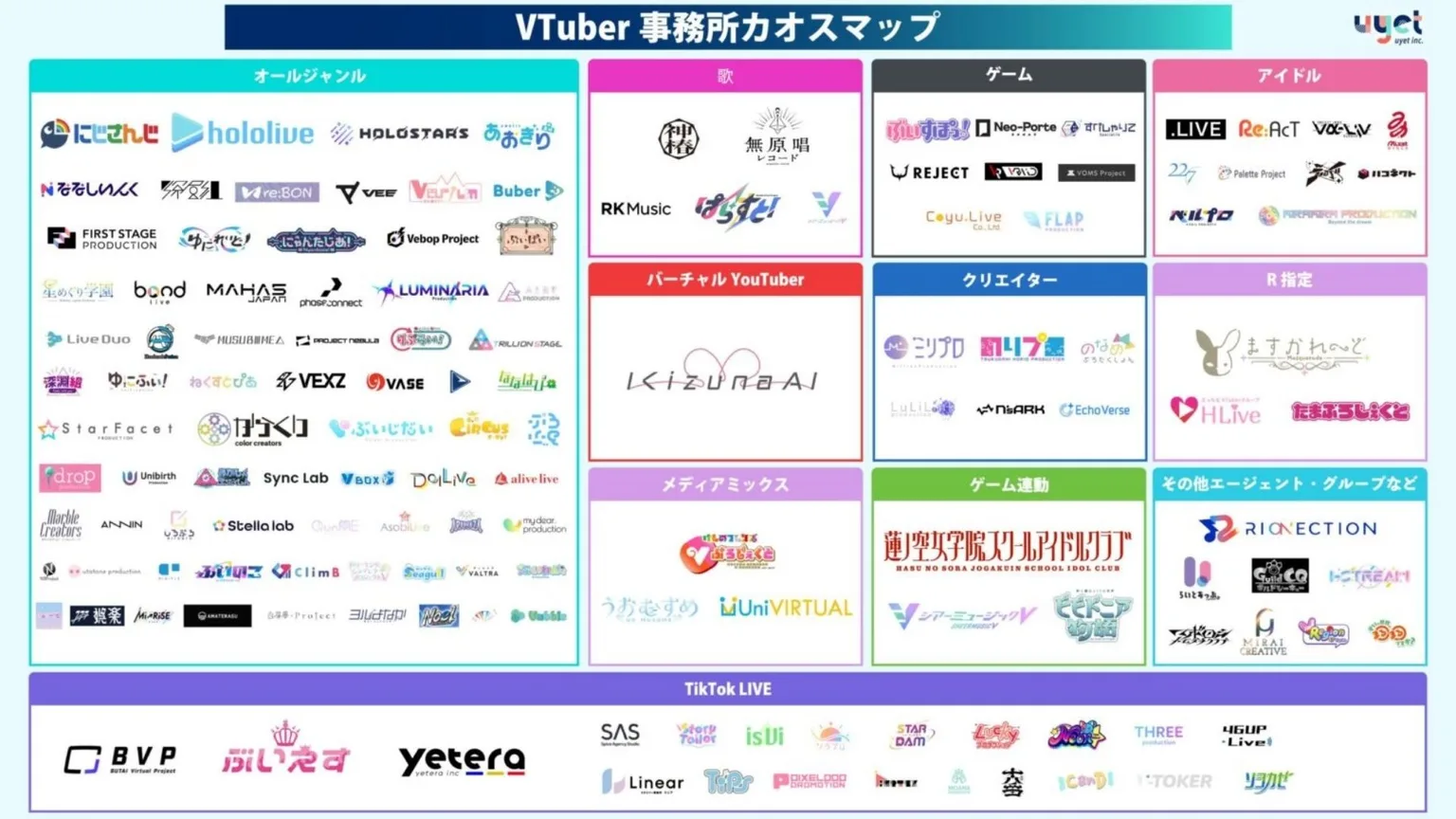
The agency landscape itself has grown quite a bit since VTubing’s early days. According to uyet’s 2026 VTuber agency chaos map, roughly 120 agencies are now categorized by genre and specialty, including a newly added “TikTok LIVE” category for agencies built around that platform specifically. Uyet estimates more than 200 VTuber agencies are active in total, which says a lot about how fragmented and specialized this space has become. If you want to dig deeper into how these agencies stack up, definitely check out uyet’s full article which is linked above (and full credit to their team for putting this map together!). Underneath all this structure, VTubers mostly earn through ad revenue, donations, sponsorships, and merchandise, though it’s usually only the top tier of talent that draws enough viewership to catch a sponsor’s eye.
That sponsorship interest, when it does show up, can turn into something much bigger than a single stream. Take Hololive Night, Hololive production’s ongoing collaboration with the Los Angeles Dodgers. What started in July 2024 as a one-off event, billed as the world’s first collaboration between a VTuber and an MLB team, has since become an annual tradition. The 2025 edition built on the original with the first-ever VTuber livestream broadcast to and from Dodger Stadium, co-branded merchandise, and a ceremonial first pitch thrown by Hololive’s own CEO. Rather than a single sponsored appearance, this has grown into a partnership that keeps expanding year over year.

This kind of long-term payoff really comes down to how VTuber fans behave. Beyond just watching a sponsored stream, these audiences love to make it their own: Fan art, clips, and social posts that keep circulating well after the original broadcast ends. That organic amplification means a single VTuber sponsorship can reach an audience far beyond its original viewers, all without extra spend from the brand. For sponsors, it turns one partnership into something that keeps paying off long after the cameras stop rolling.
Taken together, this data shows that VTubers have grown from a niche Japanese subculture into one of live streaming’s fastest-growing and most collaborative genres, with a handful of dominant agencies, creator-led tournaments, and milestone events driving hours watched to record highs, all while leaving room for independent talent and creator-founded agencies to carve out their own space at the very top.
This growth shows no signs of slowing down. As the technology behind VTubing becomes cheaper and more accessible, expect to see an even wider range of characters and niches emerge beyond the anime-inspired mold that’s dominated the space so far, appealing to audiences who want something a little different from the norm. This matters most for younger viewers, many of whom have grown up alongside VTubers as a completely normal part of online content rather than a novelty, and brands looking to reach that demographic would do well to take notice now rather than later. For publishers and brands looking to find the right VTuber partner for their next campaign, Hatchet’s AI Discovery Tool can help identify the best-fit creators for influencer marketing efforts.
To get the latest insights impacting streaming and socials, follow Hatchet and receive exclusive newsletter-only content: